
METHOD AT A GLANCE
The numbers before you start
This is the operational baseline: heat, time, equipment, size, form, and batch discipline. Exact timing still moves with shrimp size, starting temperature, shell state, and appliance.
Set the cooking environment before shrimp enter it.
Use the clock to know when to start checking—not as permission to ignore the shrimp.
The right vessel makes temperature control easier.
Size changes the margin between surface result and an overcooked center.
Shell and processing state can materially change execution.
Batching is part of the method, not a cleanup detail.
THE METHOD ITSELF
How to nail raw & acid-cured
Raw service is a sourcing and cold-chain decision first. Acid changes shrimp protein and texture, but it does not convert an uncertain raw product into a safe one.
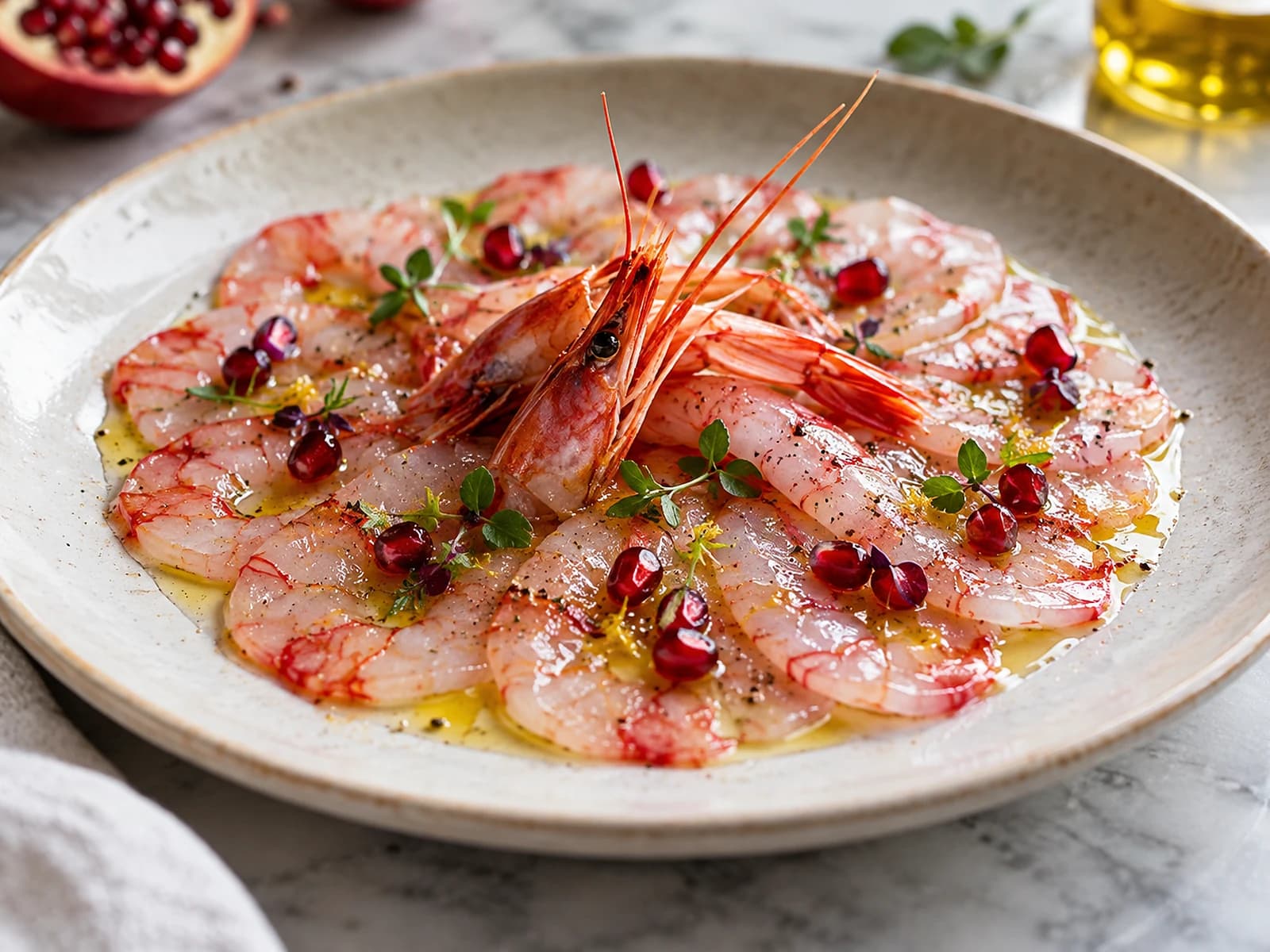
Crudo / nigiri-style service
Choose the source before the recipe
Use shrimp specifically selected for raw service from a trusted purveyor with a clear handling history. Ordinary commodity shrimp should not be promoted into raw service by recipe technique.
Keep everything cold
Thaw under refrigeration when applicable. Keep the shrimp, knife, tray, and finished plate cold and minimize time on the counter.
Prep cleanly
Peel, devein, and trim with a sharp knife. Dry the surface gently so the final seasoning is not diluted.
Dress minimally
Salt and season immediately before serving. Citrus, oil, herbs, chile, or soy should support the shrimp rather than become a long marinade.
Acid cure / ceviche / aguachile
Start from raw-service-quality shrimp
Acid is not a safety workaround. Begin with the same sourcing and cold-chain standard you would use for crudo.
Cut for an even cure
Butterfly or slice thick shrimp so the acid contacts the flesh evenly; very thick whole shrimp cure unevenly.
Add acid and start the clock
Lime or another acidic dressing begins firming the exterior quickly. Around 10–15 minutes keeps a more tender center; 20–30 minutes produces a firmer, more opaque texture.
Stop at the texture you want
Drain or finish the dressing when the shrimp reaches the desired firmness. Leaving it in acid indefinitely continues tightening the proteins and can turn the texture chalky.
Season and serve cold
Balance salt, chile, herbs, and cooling ingredients at the end and serve promptly in chilled bowls or plates.
TIMING & DONENESS
Know when to stop
There is no heat doneness cue. Acid turns the flesh opaque and firmer, but that is a texture change—not proof of pathogen control.
Dress only at the last moment so texture and temperature stay clean.
Firmer exterior with a more tender center, depending on cut thickness.
More opaque, firmer texture. Longer is not safer—only firmer.
What good looks like
TROUBLESHOOTING
Method-specific failure modes
These are the mistakes that belong to this cooking method—not another repetition of generic thawing advice.
Using acid as a safety step
Lime juice changes texture but does not reliably eliminate seafood pathogens. If the handling history is uncertain, switch to a cooked method.
Warm mise en place
Raw seafood should not spend the prep session warming at room temperature. Work in small cold batches.
Chalky cure
The shrimp sat in acid too long. Shorten the cure or use a thicker cut next time.
Recovery: Acid cannot make unsafe shrimp safe. If shrimp were safely refrigerated but are unsuitable for raw service, cook them thoroughly. Discard shrimp after unsafe time or temperature handling; cooking is not a remedy for spoilage or mishandling. Discard perishables left out over 2 hours, or over 1 hour above 90°F / 32°C.
MAKE IT TONIGHT
Recipes that use raw & acid-cured
These published Playbooks are mapped to this method. Open a recipe for its ingredients, preparation and image details.
No published Launch 20 recipe is mapped to this method yet.
SPECIES INTERSECTION
Which shrimp fit this method?
Now that the technique is explicit, species fit has context. Good matches provide enough size, structure, or handling margin for this method; watch and avoid states stay visible.
No special watch state recorded.
PRODUCT INTERSECTION
Real bags that fit
These catalogue products clear the method recommendation. Product processing still has the final say, so each bag opens into its own full verdict.
No listed product currently has enough information to recommend for this method.
PROCESSING INTERSECTION
Processing can change the answer
A species can be a good fit while a specific bag is not. These processing states are the ones the recommendation engine treats as relevant to this method.
Hours to days of chilled transport happen first, with autolysis running the whole time - and for pandalids that clock is fast, with myosin heavy chain degradation detectable within five hours on ice. Then the product freezes, often as a block with a long thermal path to the centre, so interior shrimp cross the damage band slowly. The physics is peer-reviewed; the block-versus-IQF comparison itself is industry assertion, with no head-to-head trial found.
Freezing rate sets ice crystal size: above 2 cm/h gives 10-50 micron crystals confined to interstitial spaces, against 100-300 micron dendritic crystals that pierce membranes below 0.5 cm/h. Frozen at sea crosses the -1 to -5C damage band once, fast, hours after capture, and before autolysis has run. It is also what underwrites raw service for Groups B and C, and it is why royal red and Argentine red are frozen on board as standard - the heads degrade at surface temperature. Note the state does NOT by itself satisfy the Food Code parameters: commercial product held at -18C does not meet the -20C for 7 days requirement.
This is previously-frozen product that has taken an extra freeze-thaw cycle plus an unknown period at counter temperature - time spent walking through both the cathepsin optimum band and the bacterial growth range. Freeze-thaw damage is monotonic in cycles: after 21 cycles colony counts and TVB-N exceed the edible standard, with hardness, elasticity and chewiness all declining, and the published recommendation is fewer than eight. The consumer consequence is blunt and worth stating plainly on every page: buying the same product still frozen and thawing it once at home is strictly less damage.
Hardness is an integral of time at temperature, and cook loss, shrinkage and hardness correlate at 97.8, 92.3 and 88.4 percent. Every reheat moves further up the same monotonic curve and nothing re-hydrates. The only technical route back is very prolonged braising, which softens via collagen-to-gelatin at the cost of everything else. DIRECT ANSWER to the brief's question: for a precooked salad-shrimp bag, Group B membership no longer decides anything about METHOD - R15 has decided all eight cells. What group membership still decides is flavour framing (what to dress it with) and the purchasing lesson (that raw-grade amaebi is a different product on the same shelf). Therefore the Use block must ask what STATE the bag is in BEFORE it asks what species it is.
WHY IT WORKS
The cooking logic underneath the method
The method page should teach a cook how to execute first. The science belongs here to explain the result, not to replace the methodology.
Raw & acid-cured, explained
Acid denatures muscle proteins and makes the shrimp firmer and more opaque, which resembles some effects of heat. That chemistry is not the same as a validated pathogen kill step.